


ISO 20000 Lead Auditor Training: Complete 2026 Guide
What is ISO 20000 Lead Auditor Training?
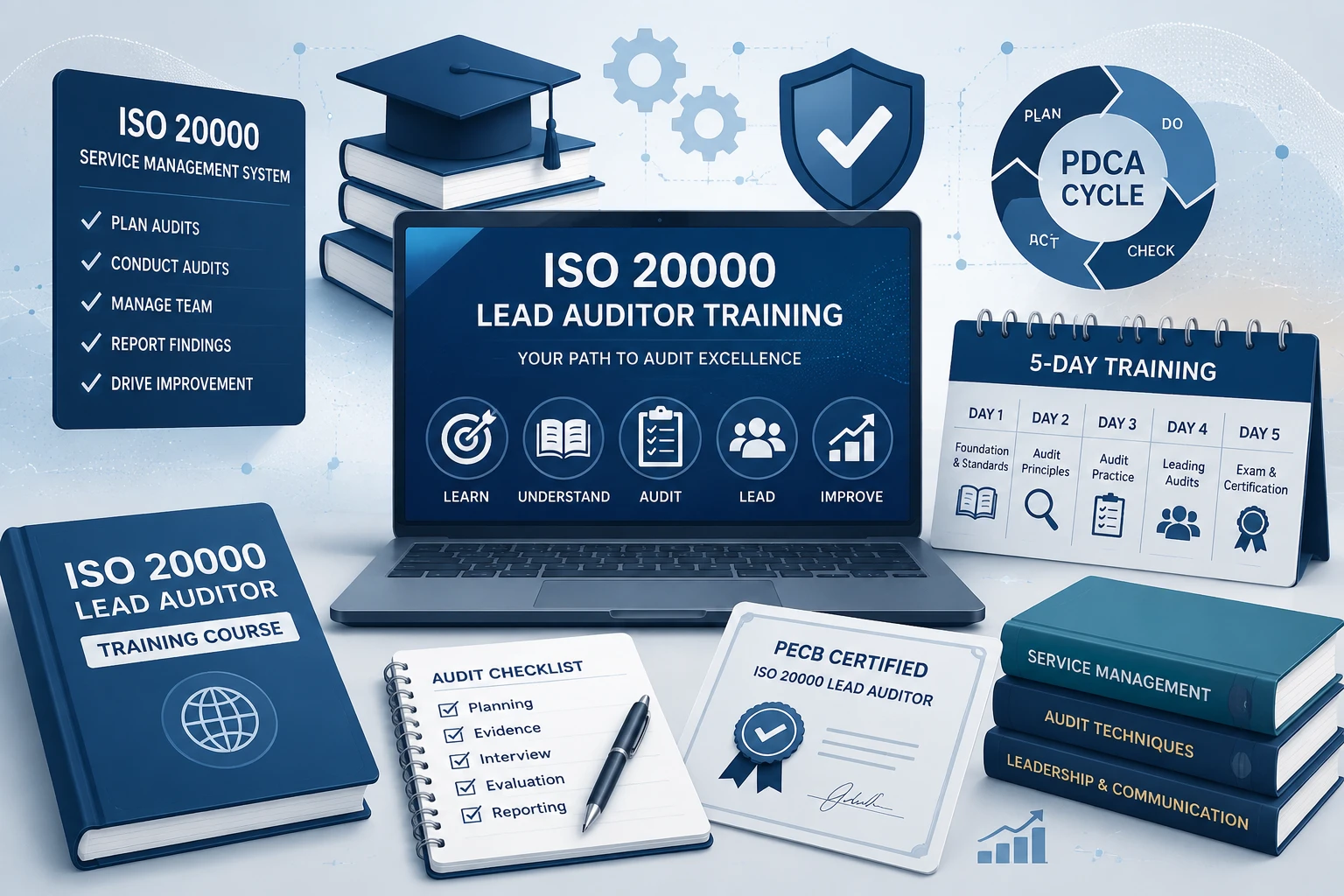
ISO 20000 Lead Auditor Training is a five-day professional course that develops the knowledge and skills needed to plan, conduct, report, and lead audits of a service management system against ISO/IEC 20000-1. The PECB course applies recognized audit principles, ISO 19011 guidance, and relevant elements of the ISO/IEC 17021-1 certification process.
What should you know before taking ISO 20000 Lead Auditor Training?
This 2026 guide explains the course structure, learning objectives, prerequisites, examination, credential levels, experience requirements, training formats, and the difference between completing the course and earning the full Lead Auditor credential.
ISO 20000 Lead Auditor Training is intended for auditors, service management professionals, consultants, and managers who need to evaluate whether a service management system conforms to defined requirements and operates effectively.
The training can also support professionals pursuing a PECB ISO/IEC 20000 auditor credential. Completing the course and passing the examination do not automatically grant the full Lead Auditor designation.
Candidates must separately satisfy the professional experience, service management experience, audit-hour, and ethical requirements associated with the credential they select.
Effective service management audits depend on sound judgment, reliable evidence, and a clear understanding of ISO/IEC 20000-1. Lead Auditor Training helps professionals test whether processes work in practice, document defensible findings, and coordinate audits without imposing personal preferences on the organization being assessed.
What Does ISO 20000 Lead Auditor Training Cover?
PECB ISO/IEC 20000 Lead Auditor is a five-day course focused on auditing service management systems. It teaches participants how to interpret ISO/IEC 20000-1 requirements from an auditor’s perspective.
The course also addresses recognized auditing principles, ISO 19011 guidance, and relevant parts of the ISO/IEC 17021-1 management-system certification process.
Participants learn how to evaluate a service management system using several forms of objective evidence:
- Interviews with personnel
- Observation of operational activities
- Review of controlled documents
- Sampling of service management records
- Evaluation of performance results
- Review of corrective actions and improvements
The emphasis is on determining conformity and effectiveness. Confirming that a policy or procedure exists is not enough when operational evidence shows that the process is not consistently applied.
The current requirements standard is ISO/IEC 20000-1:2018, including Amendment 1:2024 on climate action changes.
Why Is ISO 20000 Lead Auditor Training Useful?
A service management system audit requires more than knowledge of service desk activities. Auditors must understand governance, scope, risk, operational controls, performance evaluation, corrective action, and continual improvement.
The training develops a structured approach to the complete audit lifecycle:
- Interpreting ISO/IEC 20000-1 requirements
- Defining audit objectives, scope, and criteria
- Preparing audit plans and working documents
- Conducting opening and closing meetings
- Interviewing personnel
- Collecting and verifying audit evidence
- Evaluating conformity and effectiveness
- Documenting nonconformities
- Preparing audit reports
- Following up on corrective actions
- Coordinating an audit team
- Managing an audit program
These capabilities can support internal audits, supplier audits, readiness assessments, and other service management assurance activities.
Performing certification audits for a certification body may require additional experience, sector competence, witnessed audits, and formal authorization beyond completing the training.
Who Should Attend the Training?
The course is intended for professionals who audit, evaluate, or provide assurance over service management systems.
Suitable participants include:
- Auditors who want to conduct or lead service management system audits
- Internal auditors and assurance professionals
- Service management managers and process owners
- Consultants advising organizations on ISO/IEC 20000-1
- Professionals responsible for maintaining conformity
- Technical experts supporting certification-audit preparation
- Audit program managers
- Governance, risk, and compliance professionals
- Expert advisers in service management
The training is most useful when participants already understand how service management activities operate in a real organization.
What Are the Course Prerequisites?
PECB identifies two main prerequisites for participating in ISO 20000 Lead Auditor Training.
- A fundamental understanding of ISO/IEC 20000-1 requirements
- Comprehensive knowledge of audit principles
Five years of professional experience is not required to attend the course. That experience becomes relevant when a candidate applies for the full PECB Certified ISO/IEC 20000 Lead Auditor credential.
Participants without a working understanding of ISO/IEC 20000-1 may benefit from introductory study before attempting the Lead Auditor course. Practical exposure to incidents, changes, service levels, suppliers, risks, and improvements can also make the exercises easier to apply.
Review the ISO 20000 Lead Auditor Training course →
What Skills Will Participants Learn?
The course develops competence across the full audit process. Participants move from understanding audit criteria to planning, evidence collection, reporting, and audit-program management.
Service Management System Fundamentals
Participants review the principles of a service management system and the ISO/IEC 20000 family of standards. This foundation helps auditors interpret requirements within the organization’s service context.
Auditor Interpretation of ISO/IEC 20000-1
Auditors must distinguish between a standard requirement, the organization’s chosen control, and the evidence showing whether that control works.
The course helps participants evaluate conformity without treating personal preferences or nonmandatory guidance as audit criteria.
Audit Planning
Participants learn how to establish audit objectives, scope, criteria, methods, responsibilities, and schedules.
Effective planning also considers service complexity, organizational locations, suppliers, technologies, risks, and access to evidence.
Evidence Collection and Verification
Audit conclusions must be based on verifiable evidence. Participants learn to use interviews, observation, document review, and sampling while maintaining professional judgment.
The course also addresses situations in which records are incomplete, employees provide conflicting explanations, or the planned audit trail needs to change.
Nonconformity and Audit Reporting
Participants learn how to connect a finding to the relevant requirement and supporting evidence.
A defensible nonconformity should state what requirement was not fulfilled and identify the evidence supporting that conclusion. It should not prescribe the auditor’s preferred solution.
Audit Leadership and Program Management
Lead auditors may need to coordinate an audit team or oversee several audits. The course therefore addresses communication, team responsibilities, audit-program objectives, resources, competence, monitoring, and improvement.
How Is the Five-Day Course Structured?
PECB currently presents ISO/IEC 20000 Lead Auditor Training as a five-day course. Each day addresses a distinct part of the audit lifecycle.
Day 1: Service Management Systems and ISO/IEC 20000
The first day introduces the service management system and the ISO/IEC 20000 family of standards. It establishes the foundation needed to interpret ISO/IEC 20000-1 during an audit.
Day 2: Audit Principles, Preparation, and Initiation
The second day covers audit principles and the activities required to prepare and initiate an audit. Participants connect audit criteria with audit plans, working documents, and evidence needs.
Day 3: Conducting Audit Activities
The third day focuses on interviews, sampling, evidence evaluation, communication with the auditee, and coordination within the audit team.
Day 4: Closing the Audit
The fourth day addresses findings, nonconformity reports, closing meetings, final reporting, and follow-up activities.
Day 5: Certification Examination
The fifth day is allocated to the PECB Certified ISO/IEC 20000 Lead Auditor examination.
Schedules and examination arrangements can vary by training format and provider. Candidates should confirm the current timetable before registering.
What Does the Examination Cover?
The PECB examination evaluates knowledge across seven competency domains.
- Fundamental principles and concepts of a service management system
- Service management system requirements
- Fundamental audit concepts and principles
- Preparing an ISO/IEC 20000 audit
- Conducting an ISO/IEC 20000 audit
- Closing an ISO/IEC 20000 audit
- Managing an ISO/IEC 20000 audit program
PECB identifies the examination as part of the five-day course structure. Candidates should confirm the current format, duration, available languages, delivery arrangements, and examination policies before enrollment.
Older brochures and third-party course summaries may not reflect current examination requirements.
Is Course Completion the Same as Lead Auditor Certification?
No. Training attendance, examination completion, and professional certification are related but separate steps.
Attending the course provides structured instruction. Passing the examination demonstrates that the candidate has met the examination requirement. The credential awarded afterward depends on the candidate’s professional and audit experience.
PECB Certified ISO/IEC 20000 Provisional Auditor
This credential does not require previous professional or audit experience. The candidate must pass the applicable examination and agree to the PECB Code of Ethics.
It provides a pathway for candidates who have gained the required knowledge but have not accumulated the experience needed for a higher credential.
PECB Certified ISO/IEC 20000 Auditor
The Auditor credential currently requires:
- Two years of professional experience
- At least one year of IT service management experience
- A total of 200 hours of audit activities
- Successful completion of the applicable examination
- Agreement to the PECB Code of Ethics
Candidates must satisfy all applicable requirements before receiving the selected credential.
PECB Certified ISO/IEC 20000 Lead Auditor
The full Lead Auditor credential currently requires:
- Five years of professional experience
- At least two years of IT service management experience
- A total of 300 hours of audit activities
- Successful completion of the applicable examination
- Agreement to the PECB Code of Ethics
Passing the Lead Auditor examination does not remove these experience requirements.
PECB Certified ISO/IEC 20000 Senior Lead Auditor
The senior credential requires a higher level of professional, service management, and audit experience. Candidates pursuing this designation should review PECB’s current certification requirements before applying.
What Audit Experience May Count Toward a Credential?
PECB states that qualifying experience should involve audit activities performed according to recognized audit practices.
Relevant activities may include:
- Planning an audit
- Managing an audit program
- Reviewing documented information
- Preparing audit working documents
- Conducting audit interviews
- Performing on-site or remote audit activities
- Drafting audit and nonconformity reports
- Following up on nonconformities
- Leading an audit team
Candidates should maintain accurate records of audit dates, scope, duration, responsibilities, and completed activities. PECB determines whether submitted experience satisfies the selected credential requirements.
How Should You Prepare for the Course and Examination?
Preparation should begin with ISO/IEC 20000-1 and recognized audit principles rather than examination techniques alone.
A practical preparation plan should include:
- Reviewing the structure and requirements of ISO/IEC 20000-1
- Understanding the scope of a service management system
- Reviewing audit principles and terminology
- Distinguishing conformity from effectiveness
- Following sample audit trails across service processes
- Practicing evidence-based nonconformity statements
- Reviewing course exercises and case studies
- Confirming current examination rules
- Planning sufficient uninterrupted study time
Participants should also be comfortable reviewing incident records, change approvals, service-level reports, supplier reviews, internal audit findings, and corrective actions.
Is ISO 20000 Lead Auditor Training Difficult?
The course is intensive rather than universally easy or difficult. Participants must interpret requirements, apply audit principles, evaluate case-study evidence, and make defensible audit judgments.
Prior familiarity with ISO/IEC 20000-1 and auditing can reduce the learning curve. Candidates who rely only on memorized terminology may struggle when asked to evaluate realistic audit situations.
Understanding why evidence supports or fails to support a conclusion is more useful than memorizing isolated clauses.
How Should You Choose a Training Format?
ISO 20000 Lead Auditor Training may be available through classroom, live virtual, eLearning, or self-study delivery, depending on the provider and current schedule.
Consider the following factors before enrolling:
- Your preferred learning style
- Access to an instructor
- Opportunities for discussion and practical exercises
- Time-zone compatibility
- The course schedule
- Examination arrangements
- Included learning materials
- Retake and rescheduling policies
- Total cost rather than tuition alone
Instructor-led formats may suit participants who value live discussion and immediate feedback. Self-paced formats may be more suitable for experienced professionals who need scheduling flexibility.
Should You Choose Lead Auditor or Lead Implementer Training?
Lead Auditor Training focuses on evaluating a service management system. ISO 20000 Lead Implementer Training focuses on establishing, operating, maintaining, and improving one.
Lead Auditor Training is generally the better fit when responsibilities involve:
- Internal or external auditing
- Audit-program management
- Supplier assurance
- Certification-readiness reviews
- Evidence evaluation
- Nonconformity reporting
Lead Implementer Training may be more suitable when responsibilities involve:
- Designing the service management system
- Establishing policies and processes
- Coordinating implementation
- Assigning operational responsibilities
- Monitoring service management performance
- Preparing the organization for certification
Some professionals complete both pathways because implementation and auditing require different but complementary perspectives.
Request a seat for ISO 20000 Lead Auditor Training →
Frequently Asked Questions
How much does ISO 20000 Lead Auditor Training cost?
There is no universal course price. Fees vary by provider, country, delivery format, schedule, and included services. Confirm whether the quoted price includes course materials, the examination, certification application fees, applicable taxes, and any examination-retake entitlement.
Is ISO 20000 Lead Auditor Training hard?
The course can be demanding because it combines ISO/IEC 20000-1 requirements with practical auditing methods. Candidates with prior service management and audit knowledge are likely to find it more manageable. Focused preparation and active participation are more reliable than assuming the course will be easy.
How do you obtain a PECB ISO 20000 Lead Auditor credential?
Candidates must pass the applicable examination and apply for a credential that matches their professional and audit experience. The full PECB Certified ISO/IEC 20000 Lead Auditor credential currently requires five years of professional experience, including two years in IT service management, and 300 hours of audit activities.
How long does ISO 20000 Lead Auditor Training take?
PECB currently structures ISO/IEC 20000 Lead Auditor Training over five days. The first four days cover service management system requirements and audit activities, while the fifth day is allocated to the certification examination.
Is the examination included in PECB ISO 20000 Lead Auditor Training?
PECB states that examination and certification fees are included in the course price. Delivery and booking arrangements can vary, so candidates should confirm the examination date, applicable fees, and retake conditions with their selected training provider before enrolling.
Do I need five years of experience to attend the course?
No. Five years of professional experience is associated with the full PECB Certified ISO/IEC 20000 Lead Auditor credential, not course attendance. Participants should instead have a fundamental understanding of ISO/IEC 20000-1 and comprehensive knowledge of audit principles.
Can I earn an ISO 20000 auditor credential without previous audit experience?
A candidate who passes the applicable examination but does not meet the experience requirements may apply for the PECB Certified ISO/IEC 20000 Provisional Auditor credential. That credential does not require previous professional or audit experience, but the candidate must satisfy the applicable examination and ethical requirements.
Does the course qualify someone to perform certification audits?
Not by itself. Certification bodies determine auditor competence and authorization through their own accredited processes. Lead Auditor Training supports the required knowledge, but certification-audit work may also require relevant experience, witnessed audits, sector competence, and formal authorization.
Is ISO 20000 Lead Auditor Training available online?
Online availability depends on the current course schedule and training provider. Live virtual, eLearning, self-study, and classroom options may be available. Candidates should verify the delivery method, instructor access, practical exercises, time zone, and examination arrangements before registering.
What is the difference between an ISO 20000 internal auditor and a lead auditor?
An internal auditor evaluates the organization’s own service management system. A lead auditor may also coordinate an audit team, manage the audit process, communicate findings, and oversee reporting and follow-up. The exact authority of either role depends on the audit program and appointing organization.
Take the Next Step in ISO 20000 Audit Training
ISO 20000 Lead Auditor Training is most valuable for professionals who need to evaluate service management systems through structured, evidence-based audits.
Before enrolling, confirm that the course matches your current knowledge, intended audit role, preferred delivery method, and professional credential pathway.
Candidates seeking the full Lead Auditor credential should also review their professional experience and documented audit hours. iCertWorks provides professional training and audit-readiness support but does not issue ISO management-system certifications.