


ISO 20000 Lead Implementer Training: Complete 2026 Guide
What is ISO 20000 Lead Implementer Training?
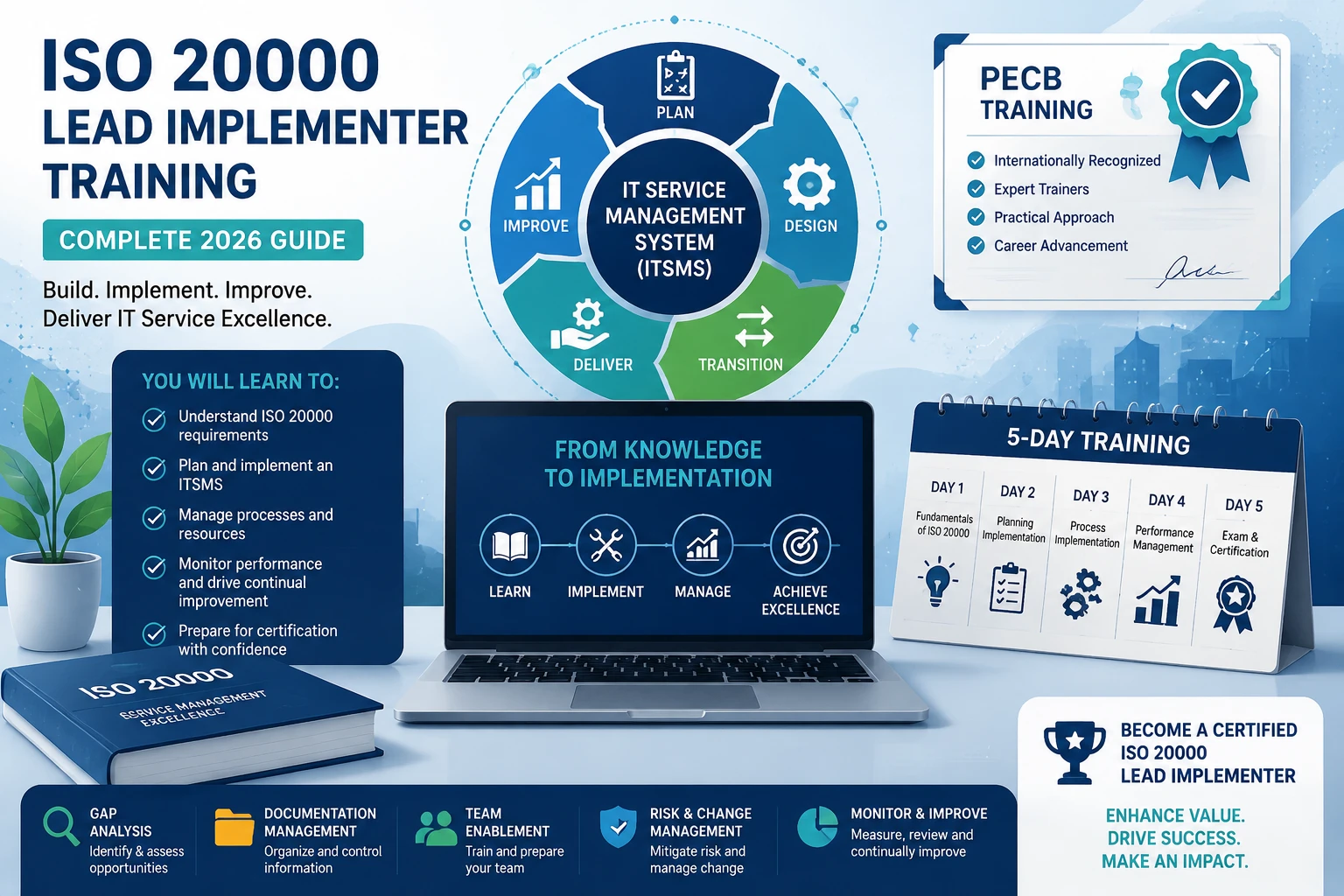
ISO 20000 Lead Implementer Training is a five-day professional course focused on planning, establishing, operating, monitoring, maintaining, and improving a service management system based on ISO/IEC 20000-1. The PECB course prepares participants to translate the standard’s requirements into practical organizational controls and implementation activities.
What should you know before taking ISO 20000 Lead Implementer Training?
This 2026 guide explains the course structure, prerequisites, implementation skills, examination topics, credential levels, project-experience requirements, training benefits, and the difference between completing the course and earning the full Lead Implementer credential.
The course is intended for managers, consultants, project leaders, service management professionals, and implementation team members responsible for turning ISO/IEC 20000-1 requirements into workable organizational processes.
Completing the course and passing the examination do not automatically grant the full PECB Certified ISO/IEC 20000 Lead Implementer credential. Candidates must also meet the professional experience, IT service management experience, project-hour, and ethical requirements for the credential they select.
ISO 20000 Lead Implementer Training matters because a service management system must work across leadership, service teams, suppliers, technologies, and operational processes. The course helps professionals turn ISO/IEC 20000-1 requirements into coordinated controls that can be monitored, maintained, and improved over time.
What Does ISO 20000 Lead Implementer Training Cover?
PECB ISO/IEC 20000 Lead Implementer is a five-day professional course focused on implementing and managing a service management system.
Participants learn how to interpret ISO/IEC 20000-1 within an organization’s operating environment. The course covers implementation planning, responsibilities, service management processes, performance monitoring, continual improvement, and preparation for a certification audit.
The current requirements standard is ISO/IEC 20000-1:2018, including Amendment 1:2024 on climate action changes.
ISO/IEC 20000-1 uses the term service management system, commonly abbreviated as SMS. The system can support services delivered to internal or external customers and is not limited to a service desk or one technical department.
Why Is Lead Implementer Training Useful?
An effective service management system must connect governance requirements with daily service delivery. Policies alone do not demonstrate that the system works.
Implementation requires coordinated decisions about scope, leadership, objectives, risks, resources, responsibilities, suppliers, operational controls, performance measurement, corrective action, and improvement.
Lead Implementer Training helps participants learn how to:
- Interpret ISO/IEC 20000-1 requirements
- Define the service management system scope
- Assess the organization’s current position
- Develop an implementation plan
- Assign responsibilities and process ownership
- Establish controlled service management processes
- Define objectives and performance measures
- Integrate suppliers and supporting functions
- Monitor service management performance
- Address nonconformities and corrective actions
- Support internal audits and management reviews
- Prepare for a certification audit
- Maintain and continually improve the system
The course does not guarantee organizational certification. It develops the competence needed to support implementation and readiness activities.
Who Should Attend the Course?
The course is designed for professionals involved in implementing, operating, maintaining, or improving a service management system.
Suitable participants include:
- Service management managers
- IT service management professionals
- Project managers and implementation program leaders
- Consultants and expert advisers
- Process and service owners
- Governance, risk, and compliance professionals
- Service management system implementation team members
- Professionals responsible for ISO/IEC 20000-1 conformity
- Internal auditors seeking an implementation perspective
- Technical experts supporting service management processes
The course is particularly useful for professionals who must coordinate implementation across several teams, services, or locations.
What Are the Course Prerequisites?
PECB identifies three areas of knowledge as the main preparation for attending the course:
- Basic knowledge of ISO management-system standards
- A general understanding of ISO/IEC 20000-1
- Awareness of management-system implementation principles
Five years of professional experience is not required to attend the training. That requirement applies to the full PECB Certified ISO/IEC 20000 Lead Implementer credential.
The relevant experience area is IT service management, not security management systems. Candidates seeking an experienced credential must also document qualifying service management system project activities.
Participants without prior exposure to ISO/IEC 20000-1 may benefit from foundation-level study before attending the Lead Implementer course.
Review the ISO 20000 Lead Implementer Training course →
What Will Participants Learn?
The course covers the complete service management system implementation lifecycle, from establishing the organizational foundation to monitoring results and preparing for certification.
Understanding the Service Management System
Participants review the purpose and structure of ISO/IEC 20000-1 and its relationship with the wider ISO/IEC 20000 family.
The course explains how organizational context, interested parties, leadership, planning, support, operations, performance evaluation, and improvement fit together within one management system.
Interpreting ISO/IEC 20000-1 Requirements
Implementation requires more than copying the standard’s language into policies and procedures.
Participants learn how to interpret requirements within an organization’s operating environment. The controls selected should reflect the services, risks, customers, technologies, suppliers, and resources included within the system.
Defining Scope and Governance
The service management system scope establishes which services, organizational units, locations, technologies, and dependencies are covered.
Participants learn how to connect the scope with leadership responsibilities, policies, objectives, resources, process ownership, and organizational decision-making.
Planning the Implementation
A credible implementation plan identifies activities, dependencies, owners, resources, milestones, risks, and expected evidence.
Participants learn how to assess the current system, prioritize gaps, sequence activities, and avoid treating every requirement as a separate documentation task.
Implementing Service Management Processes
The course addresses the practical implementation and integration of service management activities.
Depending on the organization, implementation may cover:
- Service planning
- Service portfolio and catalog controls
- Service-level and relationship management
- Supplier management
- Budgeting and accounting for services
- Demand and capacity management
- Change, release, and deployment controls
- Incident and service-request management
- Problem management
- Service availability and continuity
- Information security management
- Configuration management
- Performance reporting
- Corrective action and continual improvement
The objective is not to create a separate process for every heading. The organization should design a connected system proportionate to its services and risks.
Monitoring and Improving the System
Implementation continues after the initial processes are introduced.
Participants learn how to establish measures, review results, conduct internal audits, support management reviews, address nonconformities, and evaluate whether corrective actions are effective.
Continual improvement should be based on evidence and organizational priorities rather than a list of unrelated ideas.
Preparing for the Certification Audit
The course addresses preparation for an organizational service management system certification audit.
Participants learn how to organize evidence, assess readiness, support employee awareness, resolve internal findings, and demonstrate that implemented processes work in practice.
Training a Lead Implementer does not certify the organization. A qualified certification body independently conducts the certification audit and makes the certification decision.
How Is the Five-Day Course Structured?
PECB currently structures ISO/IEC 20000 Lead Implementer Training over five days. Each day addresses a different part of the implementation lifecycle.
Day 1: ISO/IEC 20000 and System Initiation
The first day introduces the ISO/IEC 20000 series and the activities needed to initiate a service management system.
Participants examine organizational context, scope, interested parties, leadership, and the business case for implementation.
Day 2: Implementation Planning
The second day focuses on the current-state assessment, implementation priorities, responsibilities, resources, risks, project governance, and documented information.
Day 3: Service Management System Implementation
The third day covers practical implementation of service management system requirements and operating processes across services, teams, technologies, suppliers, and supporting functions.
Day 4: Monitoring, Improvement, and Audit Preparation
The fourth day addresses monitoring, measurement, internal auditing, management review, corrective action, continual improvement, and preparation for the certification audit.
Day 5: Certification Examination
The fifth day is allocated to the PECB Certified ISO/IEC 20000 Lead Implementer examination.
Schedules and examination arrangements can vary by delivery format and provider. Candidates should confirm the current timetable before registering.
What Does the Examination Cover?
The examination evaluates knowledge across seven competency domains:
- Fundamental principles and concepts of a service management system
- Service management system requirements
- Planning an ISO/IEC 20000-1 implementation
- Implementing a service management system
- Monitoring and measuring the service management system
- Continually improving the service management system
- Preparing for a service management system certification audit
Candidates should consult current PECB examination information for the format, available languages, duration, and applicable rules.
Is Course Completion the Same as Lead Implementer Certification?
No. Course attendance, examination completion, and professional certification are separate stages.
After passing the applicable examination, a candidate can apply for the credential that matches their professional and project experience.
PECB Certified ISO/IEC 20000 Provisional Implementer
This credential does not require previous professional or implementation-project experience.
The candidate must pass the applicable examination and agree to the PECB Code of Ethics. It provides a pathway for candidates who have developed the required knowledge but do not yet qualify for a more experienced credential.
PECB Certified ISO/IEC 20000 Implementer
The Implementer credential currently requires:
- Two years of professional experience
- At least one year of IT service management experience
- A total of 200 hours of project activities
- Successful completion of the applicable examination
- Agreement to the PECB Code of Ethics
Candidates must satisfy all applicable requirements before receiving the selected credential.
PECB Certified ISO/IEC 20000 Lead Implementer
The full Lead Implementer credential currently requires:
- Five years of professional experience
- At least two years of IT service management experience
- A total of 300 hours of project activities
- Successful completion of the applicable examination
- Agreement to the PECB Code of Ethics
Passing the examination does not remove these experience requirements.
PECB Certified ISO/IEC 20000 Senior Lead Implementer
The senior credential requires a higher level of professional, IT service management, and project experience. Candidates should review PECB’s current certification requirements before applying.
What Project Experience May Count Toward a Credential?
PECB identifies several forms of service management system project activity that may contribute to the experience requirement:
- Drafting an implementation plan
- Initiating a service management system implementation
- Implementing the service management system
- Managing, monitoring, and maintaining the system
- Identifying and acting on continual improvement opportunities
Candidates should maintain accurate records of project dates, responsibilities, activities, hours, and organizational context. PECB determines whether submitted experience satisfies the selected credential requirements.
What Are the Practical Benefits of the Training?
The value of the training depends on how participants apply what they learn.
For professionals, the course can support:
- A clearer understanding of ISO/IEC 20000-1
- More structured implementation planning
- Stronger coordination across service teams
- Better communication with leadership and auditors
- Improved ability to identify implementation gaps
- Development toward a PECB professional credential
For organizations, trained personnel may help:
- Translate requirements into workable controls
- Define clearer responsibilities
- Coordinate implementation activities
- Reduce gaps between policies and operations
- Improve evidence for internal and certification audits
- Establish more reliable monitoring and improvement practices
Training does not guarantee employment, higher pay, compliance, or organizational certification. Those outcomes depend on experience, performance, implementation quality, and decisions made by employers or certification bodies.
How Should You Prepare for the Course?
Preparation should focus on understanding how a service management system works as a connected management framework.
A practical preparation plan should include:
- Reviewing the structure of ISO/IEC 20000-1
- Understanding the organization’s service environment
- Reviewing service management terminology
- Studying management-system implementation principles
- Identifying dependencies on teams, suppliers, and technologies
- Reviewing examples of service objectives and measures
- Understanding internal audit and management review
- Becoming familiar with corrective action
- Confirming current examination rules
Participants with access to a service environment can also review existing incident, change, supplier, service-level, continuity, and improvement records.
Should You Choose Lead Implementer or Lead Auditor Training?
Lead Implementer Training focuses on building and improving a service management system. ISO 20000 Lead Auditor Training focuses on evaluating one.
Lead Implementer Training is generally more suitable when responsibilities include:
- Defining the implementation approach
- Establishing policies and processes
- Coordinating service management projects
- Assigning responsibilities
- Managing implementation risks
- Monitoring system performance
- Preparing the organization for certification
Lead Auditor Training may be more suitable when responsibilities include:
- Planning and conducting audits
- Evaluating objective evidence
- Managing an audit program
- Interviewing personnel
- Reporting nonconformities
- Following up on corrective actions
- Leading an audit team
Some professionals complete both pathways because implementation and auditing require different but complementary skills.
How Is ISO 20000 Different From ITIL?
ISO/IEC 20000-1 is a requirements standard for a service management system. An organization can be independently audited against its requirements and may pursue management-system certification.
ITIL is a service management framework containing concepts, practices, and guidance. Relevant ITIL practices can support implementation, but ITIL does not replace applicable ISO/IEC 20000-1 requirements.
The two can be used together. Organizations should select practices that suit their services, risks, objectives, and operating model rather than assume that adopting ITIL automatically establishes conformity.
Request a seat for ISO 20000 Lead Implementer Training →
Frequently Asked Questions
What does ISO 20000 certification cost?
There is no universal certification price. A certification body considers factors such as scope, employee numbers, locations, service complexity, suppliers, audit duration, and travel. Training fees and organizational certification-audit fees are separate costs.
How is ISO 20000 different from ITIL?
ISO/IEC 20000-1 specifies auditable requirements for a service management system. ITIL provides service management guidance and practices. ITIL can support implementation, but using ITIL does not automatically demonstrate conformity with ISO/IEC 20000-1.
How long does ISO 20000 certification last?
Management-system certification commonly operates on a three-year cycle, subject to surveillance activities and successful recertification. The selected certification body determines the precise schedule and conditions for maintaining certification.
Is it difficult to obtain ISO 20000 certification?
The level of difficulty depends on the organization’s scope, maturity, complexity, resources, and existing service management controls. Certification requires implemented processes and objective evidence, not training alone. A gap analysis and internal audit can help identify readiness issues.
How long does ISO 20000 Lead Implementer Training take?
PECB currently structures the course over five days. The first four days cover implementation and management topics, while the fifth day is allocated to the certification examination.
Do I need five years of experience to attend the course?
No. Five years of professional experience is associated with the full Lead Implementer credential, not course attendance. Participants should have basic knowledge of ISO management-system standards, a general understanding of ISO/IEC 20000-1, and awareness of implementation principles.
Can I earn a credential without implementation experience?
Candidates who pass the applicable examination but do not meet the professional and project-experience requirements may apply for the PECB Certified ISO/IEC 20000 Provisional Implementer credential. The candidate must also agree to the PECB Code of Ethics.
Does Lead Implementer Training certify an organization?
No. The training concerns professional knowledge and competence. Organizational ISO 20000 certification requires a separate audit and certification decision by a qualified certification body.
Is ISO 20000 Lead Implementer Training available online?
Availability depends on the provider’s current schedule. Classroom, live virtual, eLearning, or self-study options may be available. Confirm the delivery method, instructor access, course materials, examination arrangements, and time zone before enrolling.
What is the difference between an ISO 20000 implementer and a lead implementer?
An implementer supports service management system implementation activities. A lead implementer is expected to coordinate the wider implementation, including planning, responsibilities, resources, monitoring, improvement, and certification-readiness activities. Actual authority depends on the organization and assigned role.
Take the Next Step in ISO 20000 Implementation Training
ISO 20000 Lead Implementer Training is most valuable for professionals responsible for turning ISO/IEC 20000-1 requirements into an operational service management system.
Before enrolling, confirm that the course matches your current knowledge, implementation responsibilities, preferred delivery format, and intended credential pathway.
Candidates seeking the full Lead Implementer credential should also review their professional experience and documented project hours. iCertWorks provides professional training and audit-readiness support but does not issue ISO management-system certifications.